Most people use these two words as if they mean the same thing. They don’t, and the difference between tree trimming vs. pruning matters once a saw gets involved. Around here, trees take a beating from lake-effect snow, ice, and hard wind, so how a tree gets cut can decide whether it holds up or drops a limb on the driveway.
This guide explains tree trimming vs. pruning in plain terms, based on the kind of work done in Western New York yards season after season. The crew at Prime Landscapers has seen what good cuts and bad cuts look like years later. Read on, and you will know what to ask for and what to turn down.
Tree Trimming vs. Pruning: Understanding the Key Differences
Start with the goal of the cut. Tree trimming is mostly about shape and size. It means cutting back growth that has gotten too thick or too close to a roof or a fence, and it is often done on a regular schedule to keep things tidy.
Tree pruning is more targeted. It removes specific branches to fix a problem, such as a dead limb or two branches rubbing against each other, and each cut is chosen for what it does inside the tree, not just how the yard looks. In tree trimming vs. pruning, the two overlap, and a good crew will often do both in one visit. Still, knowing which one you need helps you describe the job and compare quotes fairly.
Why Tree Trimming and Pruning Are Important for Tree Health
Trees don’t heal the way people do. They seal off a wound and grow over it, which is why every cut counts. Dead and broken branches invite decay and insects, and crossing limbs scrape bark away and leave open spots.
Thinning a crowded canopy lets air and light move through, which can cut down on some leaf diseases. Weight matters in Buffalo, too. Wet snow and ice put real load on branches, and a weak joint that made it through summer can fail in January.
Regular tree care and maintenance—including routine tree trimming and pruning—catches small problems before they turn into big ones. After the October 2006 storm, when heavy snow landed on trees that still had their leaves, many weakly built trees across the area lost large limbs. A tree that gets a little attention every few years is usually cheaper to look after than one ignored until a storm makes the decision.
Best Time to Trim and Prune Trees in Buffalo, NY
Winter. That’s the short answer to when to trim trees around here. The dormant season, from late fall through early spring before buds open, is the best window for most species. Without leaves, you can see the real structure of the tree. Frozen ground also protects your lawn from heavy equipment, and many insects and fungi are inactive in the cold.
There are exceptions worth knowing. Maples and birches bleed sap if you cut them in late winter and early spring. The bleeding looks alarming but doesn’t usually harm the tree, and if it bothers you, wait until the leaves are fully out.
Oaks should be left alone from about mid-April through mid-July because of oak wilt, a disease that spreads through fresh cuts. Spring bloomers like crabapple and lilac should be pruned right after they flower, or you cut off next year’s blossoms. A dead or hazardous branch can come off at any time of year.
Tree Pruning for Young vs. Mature Trees
A young tree is easy to fix. A few small cuts in the first several years set the structure for decades. The goal is one strong central leader, branches spaced out along the trunk, and no two limbs competing for the same spot. Small cuts close fast, so a little time spent early prevents the kind of problem that needs a bucket truck later.
Mature trees call for a lighter hand. At that stage, the work is mostly removing dead wood, taking out crossing or damaged limbs, and thinning where the canopy is too dense.
A good rule from the International Society of Arboriculture is to take no more than about a quarter of the live crown in one season. Big cuts on old trees close slowly, so each one needs a reason. Tree pruning on a mature maple or oak is a judgment call, not a haircut.
Common Tree Trimming and Pruning Techniques
Arborists use a few standard tree trimming and pruning approaches, and the names help when you read an estimate. Crown cleaning removes dead, diseased, and broken branches. Crown thinning selectively removes live branches to open up the canopy and reduce weight, without changing the tree’s overall size.
Crown raising takes off lower limbs so you can walk under the tree or clear a driveway, and crown reduction shortens the tree by cutting back to side branches large enough to take over as the new tip.
Where the cut goes matters as much as which branch you pick, a proper cut sits just outside the branch collar, the slightly swollen ring where a limb meets the trunk. That ring holds the tree’s own healing tissue. For large limbs, pros use a three-cut method so the weight of the branch doesn’t rip a strip of bark down the trunk as it falls.
Signs Your Trees Need Trimming or Pruning
Some signs are easy to spot. Branches that stay bare in midsummer are usually dead. Cracks, splits, and limbs hanging by a thread need attention soon, and so does anything rubbing your roof or siding. Look at the base, too. Mushrooms growing there and bark peeling off in sheets can point to decay inside.
Thinning tops on ash trees deserve a closer look. Emerald ash borer has been in Western New York for years, and an ash with a sparse crown, woodpecker damage, or small D-shaped holes in the bark may be infested. Tree pruning won’t fix that, and the tree may need treatment or removal, so call an arborist early. If you aren’t sure what you are looking at, a quick tree health check is worth more than guessing.
DIY Tree Trimming vs. Hiring Professional Tree Services
Some tree trimming jobs are fine for a homeowner. Small branches you can reach from the ground, under about two inches thick, can come off with hand pruners, loppers, or a pole saw. Keep your feet on the ground and wear eye protection and a hard hat.
The line is closer than most people think. Anything near a power line should be left to professionals, and the usual advice is to stay at least ten feet away and treat every line as live.
Chainsaws on ladders are a bad idea, since falls from ladders are a common cause of injury in tree work. Storm-damaged limbs under tension can snap back without warning. A bad DIY cut also stays with the tree for years, so the cheap option sometimes costs more in the end.
How Professional Arborists Decide Which Branches to Cut
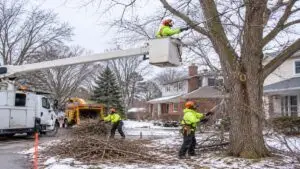
Good tree trimming and pruning starts on the ground. Before any saw starts, an experienced crew walks around the whole tree and looks up into it. At Prime Landscapers, that walk comes first because the tree shows you what it needs if you take a minute to read it. The first questions are what the species is, how old it looks, and what the owner wants fixed.
Then comes structure. Arborists look for two trunks competing at a tight angle, bark pinched between them, dead wood, and signs of decay. They also think about where a limb would land if it let go.
The best plan usually uses the fewest cuts that solve the problem. A certified arborist through the ISA has been trained on exactly this kind of decision, which is one reason to ask for that credential.
Common Tree Trimming and Pruning Mistakes to Avoid
Topping is the big one. That means chopping main stems back to stubs, and it is still sold as “trimming” by some outfits. The tree responds by pushing out weak, fast-growing shoots that break easily, and the stubs often rot. Flush cuts, which slice right against the trunk, damage the collar and slow healing. Leaving long stubs does the opposite and invites decay.
Wound paint is another myth, since trees generally do better without it. Over-thinning, sometimes called lion-tailing, strips the inner branches and leaves tufts at the ends, which puts stress on the limbs. Timing counts as well, so pruning an oak in summer can cause real trouble. When cutting out a diseased branch, such as fire blight on a crabapple, clean your tools between cuts so you don’t carry the disease to healthy wood.
Choosing a Professional Tree Service in Buffalo, NY
Ask for proof, not promises. A reliable tree service Buffalo NY homeowners can trust should carry liability insurance and workers’ compensation, and you should be able to see both. Ask whether anyone on the crew is an ISA Certified Arborist. Get a written estimate that says which trees, what work, and whether cleanup and haul-off are included.
Be cautious of anyone who knocks on doors after a storm or suggests topping a tree. Check local reviews and ask for references from jobs in your area, whether that’s Amherst, Orchard Park, Hamburg, or the city itself.
Also check with the City of Buffalo before cutting a street tree, since trees in the public right-of-way are generally the city’s responsibility. Prime Landscapers is happy to answer these same questions, and you should ask them of anyone who bids on your trees.
Frequently Asked Questions
Is tree trimming the same as pruning?
Not quite. In tree trimming vs. pruning, trimming shapes and controls size, while pruning removes specific branches to fix a health or structure problem. In practice a crew often does both in one visit, but the reason behind each cut is different.
What is the best month to trim trees in Buffalo?
Late winter, before buds open, works well for most trees. The leaves are off, the structure is easy to see, and frozen ground protects your lawn. Oaks should avoid mid-April through mid-July, and spring bloomers wait until after flowering.
Can I prune trees in summer?
Yes, in some cases. Dead or dangerous branches can come off any time, and some trees, like maples that bleed sap, do fine with summer cuts. Heavy tree pruning in summer can stress a tree, so keep it light.
How much can I safely cut off a tree at once?
A common guideline is no more than about 25 percent of the live crown in one season. Mature trees recover slowly from heavy cuts. If the job needs more than that, spread it over a few seasons.
How often should trees be pruned?
Young trees benefit from a check every year or two while they build structure. Mature trees usually do well with a look every three to five years. Storm damage, disease, or a fast-growing species can change that schedule.
Do I need a permit to trim a street tree in Buffalo?
Trees in the public right-of-way are generally managed by the city, so check with the City of Buffalo before cutting one. Rules can differ from town to town, so call your local office if you live in the suburbs.
When should I call a professional instead of doing it myself?
Call a pro for any limb you can’t reach from the ground, anything near power lines, and any job that needs a chainsaw above shoulder height. Also call for storm damage, signs of decay, or a tree you suspect has disease.